
The Short Answer
If you want one product that conditions tired wood while leaving a warm, satin glow, start with Howard Products Feed-N-Wax Wood Polish & Conditioner. If you are sealing a fresh finish and want that classic hand-buffed sheen, Minwax Paste Finishing Wax is the workhorse. And for irreplaceable antiques or anything on display, Renaissance Wax Micro-Crystalline Polish is the conservator’s favorite for a reason.
Wood is a living material in every sense that matters to your furniture. It drinks, it dries, it expands when the humid season arrives and contracts when the heat kicks in. A good furniture wax is the quiet, unglamorous layer that stands between your favorite pieces and everyday life: the water glass that sweats, the coffee mug that slides, the afternoon sun that fades a walnut tabletop into two-tone patchwork.
But “furniture wax” is not one product. It is an entire family. There are paste waxes you buff by hand, spray polishes you mist and wipe, cream formulas that clean while they shine, plant-based waxes for kitchen surfaces, and micro-crystalline protectants borrowed from museum conservation. Choosing well means matching the formula to the finish already on your wood — and to the way you actually live with your furniture.
That is exactly what this guide does. We compare eleven popular options across the categories that matter in real homes: ease of application, quality of sheen, protective feel under a water glass, scent and ventilation, and how forgiving each formula is when you inevitably apply a little too much. Every product below earns its spot for a specific job, and we will tell you plainly which jobs they should not be doing.
Along the way, you will find a quick comparison table for fast scanning, full review blocks with pros and cons for each formula, a professional application walkthrough, and honest answers to the questions we hear most often about waxing wood. Whether you are rescuing a thrift-store dresser or protecting a dining table that already hosts homework, art projects, and Sunday dinners, this is the complete education.
At a Glance
Quick Comparison: Our Top Picks
Every product in this guide, side by side. Swipe the table horizontally on smaller screens to reach the price-check buttons.
Swipe to see more →
| # | Image | Product | Key Specs | Verdict | Where to Buy |
|---|---|---|---|---|---|
| 1 |  |
Howard Products Feed-N-Wax Wood Polish & Conditioner Top Pick Best Overall |
|
The one bottle most homes should own first. | Check Price on Amazon |
| 2 |  |
Minwax Paste Finishing Wax Best Paste Wax |
|
Classic, affordable, and endlessly proven. | Check Price on Amazon |
| 3 |  |
The Original Bee’s Wax Old World Formula Furniture Polish Best Spray Polish |
|
The grab-and-go can for busy households. | Check Price on Amazon |
| 4 |  |
Briwax Original Furniture Wax Best for Restorers |
|
A restorer’s tin with real character. | Check Price on Amazon |
| 5 |  |
Renaissance Wax Micro-Crystalline Polish Best for Antiques |
|
The museum standard for treasured pieces. | Check Price on Amazon |
| 6 |  |
Goddard’s Cabinet Makers Wax Best Traditional Paste |
|
Slow, satisfying, and beautifully traditional. | Check Price on Amazon |
| 7 |  |
Dixie Belle Best Dang Wax Best for Painted Furniture |
|
Painted-furniture projects, sorted. | Check Price on Amazon |
| 8 |  |
Guardsman Anytime Clean & Polish Best for Everyday Care |
|
The weekday workhorse for tidy homes. | Check Price on Amazon |
| 9 |  |
Parker & Bailey Furniture Cream Best Cream Polish |
|
Control and polish, without the spray drift. | Check Price on Amazon |
| 10 |  |
Walrus Oil Wood Wax Best Plant-Based |
|
Natural feel, honest finish, zero fuss. | Check Price on Amazon |
| 11 |  |
CLARK’S Cutting Board Wax Best Food-Safe |
|
Kitchen wood, handled the right way. | Check Price on Amazon |
Start with the Top Pick
Howard Feed-N-Wax handles conditioning and shine in a single, forgiving step — the ideal first bottle for most wood-filled homes.
Check Price on AmazonWhy Furniture Wax Still Matters for Wood Care
Modern furniture marketing loves a miracle spray, but wax has survived every trend cycle for a simple reason: it works at the microscopic level in a way that feels obvious at the macroscopic level. A thin film of wax fills the tiny pores and micro-scratches in a finish, levels out the way light bounces off the surface, and creates a temporary barrier that water and dust have a harder time penetrating. That is the entire trick, and it is a very good trick.
What wax does not do is equally important. Wax is not a structural repair. It will not fix deep gouges, sunken veneer, or a finish that is flaking off in sheets. Those jobs belong to fillers, sandpaper, and fresh topcoats. Think of wax as the last ten percent of a furniture care routine — the finishing touch that makes everything underneath look its best and last longer.
The Real-World Benefits
- Water resistance that buys you time. A waxed tabletop sheds condensation rings far more slowly, giving you a chance to wipe before the damage sets. If a ring does appear, our guide on how to remove water rings from wood furniture walks you through the rescue.
- A softer, warmer sheen. Wax produces that low, satiny glow associated with antiques and hand-rubbed cabinetry — not the plasticky glare of an overloaded silicone polish.
- Dust actually stays away longer. Wax leaves less static-charged surface area for dust to grip, which stretches the time between dusting sessions.
- Reversible protection. Unlike a permanent topcoat, wax can be reapplied, refreshed, or stripped and redone without harming the finish underneath. This is exactly why conservators love it.
- It conditions the look of older wood. Oil-and-wax blends revive tired-looking pieces by enriching the grain and evening out dry patches.
There is also a quiet lifestyle benefit. Waxing furniture is one of the rare household chores that is genuinely pleasant. It is slow, tactile, and immediately rewarding. Ten minutes with a soft cloth and a tin of wax will transform a dull dresser faster than almost anything else you can do at home — and if your piece has surface scuffs rather than deep damage, wax often makes them visually disappear without any sanding at all. For deeper marks, see our guide on how to remove scratches from wood furniture.
Where Wax Fits in a Complete Care Routine
The healthiest routine for wood furniture looks like this: regular dusting with a dry or barely damp cloth, occasional deeper cleaning with a proper wood cleaner, structural protection like pads and sliders for anything that moves, and then wax as the finishing layer every few months or whenever the surface starts to look tired. Sun management matters too — no wax can fully undo UV fading, so positioning and window treatments do the heavy lifting there. Our rundown of how to protect furniture from sun damage covers the placement side of the equation.
One more reason wax deserves a permanent spot under the sink: it is wonderfully multipurpose. A single tin of good paste wax often works on sealed wood, painted furniture, metal hardware, and even leather. That versatility is why the products in this guide have such devoted followings among restorers, hobby woodworkers, and design professionals alike.
Build Your Wood Care Kit
Ready to stock up? Browse the current range of furniture waxes and wood conditioners on Amazon and compare formats side by side.
Shop Furniture Wax on AmazonHow to Choose the Best Furniture Wax for Your Wood
Walking into the wax aisle — or scrolling the endless online listings — without a plan is how people end up with a cabinet full of half-used tins. The good news is that choosing well comes down to four questions: What finish is already on the wood? What kind of sheen do you want? How much effort are you willing to spend? And does the surface need to be food-safe? Work through those and the field narrows fast.
Match the Wax to the Existing Finish
This is the single most important rule. Wax behaves beautifully on cured film finishes — polyurethane, lacquer, varnish, shellac, and most painted surfaces. It also works on raw or oil-finished wood, where it helps lock in a natural look. What you want to avoid is slathering a heavy paste wax over a fresh, uncured finish, or using a solvent-heavy formula on a delicate, soft paint that has not fully hardened. When in doubt, test in a hidden spot, wait a full day, and inspect.
Decide Your Sheen Personality
- Soft satin: Oil-and-wax conditioners and cream polishes. Relaxed, natural, ideal for everyday living rooms and bedrooms.
- Hand-rubbed glow: Traditional paste waxes buffed with elbow grease. Think antique shops and cabinetry.
- Clean, crisp protection: Micro-crystalline waxes. Nearly invisible film that lets the true color of the wood speak.
- Quick refresh: Spray polishes. Lower commitment, faster application, perfect between deeper treatments.
Format Cheat Sheet
Swipe to see more →
| Wax Type | Best Used For | Effort Level | Look After Application |
|---|---|---|---|
| Paste wax | Final protective coat on finished wood, cabinetry, antiques | Moderate — apply thin, buff by hand | Warm, deep, hand-rubbed sheen |
| Oil-and-wax conditioner | Dry, dull, or neglected finished and unfinished wood | Low — wipe on, wipe off | Enriched grain with soft satin glow |
| Spray polish | Frequent dusting, quick touch-ups, busy households | Very low — mist and wipe | Light, even shine, minimal build-up |
| Cream polish | Cleaning and shining in one controlled step | Low — apply with cloth | Smooth, controlled, low-mess polish |
| Micro-crystalline wax | Antiques, display pieces, mixed materials, metal hardware | Moderate — thin coat, patience pays | Crystal-clear, non-yellowing protection |
| Food-safe wood wax | Cutting boards, butcher blocks, kitchen wood, serving pieces | Low — rub in, let it settle, buff | Natural matte-to-satin finish |
Scent, Ventilation, and Sensitivity
Traditional paste waxes often carry a noticeable solvent aroma while they flash off. That is normal, but it means ventilation matters — open a window, run a fan, and give the piece a few hours to air out before bringing it back into daily use. Water-based and cream formulas tend to be gentler on the nose, and many plant-based options smell like citrus, beeswax, or nothing at all. If anyone in the home is sensitive to fragrances or fumes, that consideration alone can decide the winner.
Prep Work Makes or Breaks the Result
Wax magnifies whatever is underneath. Dust, old polish residue, sticky spills, and grime will all show up as streaks or cloudy patches if you skip cleaning. Always start with a proper wash and dry — our complete method for how to clean wood furniture is the ideal companion to this guide. If the piece has gouges or lost veneer, handle the repairs first with the best wood filler for furniture repair, and consider fresh color work with the best paint for furniture before the wax goes anywhere near it.
Buyer’s Rule of Thumb
Choose a conditioner for dry or dull wood, a paste wax for lasting protection and sheen, a spray for weekly upkeep, and a food-safe wax for anything in the kitchen. Everything else is personal preference.
Compare Formats Before You Commit
See what paste, spray, cream, and food-safe waxes are available right now, and pick the format that fits your routine.
Browse Wax Formats on AmazonHoward Products Feed-N-Wax Wood Polish & Conditioner
Howard Products Feed-N-Wax Wood Polish & Conditioner
The do-everything bottle that turns dull, thirsty wood into something that looks genuinely cared for — often within a single treatment.
Feed-N-Wax sits in a category of its own. It is not quite a paste wax and not quite a plain polish; it is a conditioner built around beeswax and orange oil, designed to penetrate, nourish, and leave a protective glow behind. That dual personality is exactly why it tops this list. You can use it on a dry antique that has been sitting in a heated house for decades, and you can use it on a well-kept dining table that just needs a seasonal refresh. It is forgiving in the way that matters most: even if your technique is imperfect, the result still looks better than what you started with.
The orange oil component does the conditioning work, helping dissolve minor grime and revive the look of the grain, while the wax lays down a light protective film. In practice, that means one bottle replaces two steps for many people. You clean, you nourish, you shine — all in one pass with a soft cloth.
Key Features
- Beeswax and orange oil style formula that conditions while it polishes
- Wipe-on, buff-off workflow with no special tools required
- Works across finished wood, veneer, and many bare-wood projects
- Excellent at reviving dry, sun-faded, or heat-stressed surfaces
- Pairs beautifully with deeper paste wax protection if desired
What We Love
- Noticeably enriches dull wood in a single session
- Extremely forgiving application — great for beginners
- Subtle, citrus-forward scent rather than harsh fumes
- Doubles as a maintenance product and a rescue product
Keep in Mind
- Light protection compared with a true paste wax topcoat
- Very thirsty wood may need a second pass after a day
- Not intended for food-prep surfaces — use a food-safe wax there
Our Top Pick for Most Homes
Condition, polish, and protect in one forgiving step. If you buy only one wood care product this season, make it this one.
Check Price on AmazonMinwax Paste Finishing Wax
Minwax Paste Finishing Wax
The name most people picture when they hear “wax the furniture.” Straightforward, dependable, and time-tested over countless projects.
Minwax has been a fixture of workshops and home improvement aisles for generations, and its paste finishing wax is one of those rare products that does exactly what the tin promises. It goes on thin over a cured finish, is buffed to a smooth sheen, and leaves behind a protective layer that helps the surface shrug off dust, fingerprints, and light moisture. There is no learning curve to speak of, which is a big part of its enduring appeal.
Where this wax really shines — figuratively and literally — is as the final step. You have sanded, stained, and sealed your project, and now you want that last touch that makes the piece look finished rather than merely coated. A thin film of this paste wax, buffed with a clean cotton cloth, delivers exactly that classic hand-rubbed look. It also works as a maintenance layer on existing furniture, refreshing sheen on tabletops, dressers, and cabinets with minimal effort.
Key Features
- Traditional paste format that buffs to an even, attractive sheen
- Designed as a protective final coat over cured finishes and stains
- Thin application means a tin lasts through many, many projects
- Familiar, widely available, and easy to find guidance for online
- Also useful as a lubricant when hand-planing or fitting parts
What We Love
- Beautiful, classic hand-buffed finish on the first try
- Excellent value — a little product covers a lot of surface
- Predictable results on almost any cured wood finish
- Great gateway product for people new to paste wax
Keep in Mind
- Requires real buffing effort on large surfaces
- Has a noticeable solvent scent while drying — ventilate
- Not a heavy-duty conditioner for severely dry wood
The Workshop Classic
Give your finished projects the protective, hand-rubbed sheen they deserve.
Check Price on AmazonThe Original Bee’s Wax Old World Formula Furniture Polish
The Original Bee’s Wax Old World Formula Furniture Polish
A beeswax polish in spray form — the one you reach for when company is coming in twenty minutes and the sideboard looks tired.
Some products earn their place through performance; others earn it through pure convenience. The Original Bee’s Wax manages both. Its old-world beeswax formula has a loyal following precisely because it delivers an instant improvement with almost no effort: mist the surface, wipe with a soft cloth, and the wood looks revived rather than coated. There is no tinning, no buffing marathon, no waiting for haze to form. Just a quick, satisfying result.
That speed makes it the natural choice for regular upkeep rather than deep restoration. Use it on coffee tables, end tables, dressers, and wood trim as part of your normal tidying rhythm. The beeswax leaves a light protective film that helps dust release more easily next time, which quietly compounds into less work overall. And because it is a spray, it reaches spindles, turned legs, carved details, and chair backs that would be tedious to treat with a paste.
Key Features
- Spray application for fast, even coverage on large and detailed surfaces
- Beeswax-based formula with a classic, familiar character
- Excellent for dusting days and quick pre-guest touch-ups
- Light protective layer that makes future cleaning easier
- Great on ornate or carved pieces where paste wax is impractical
What We Love
- Fastest route from dull to presentable
- Wonderful on carved, spindled, or detailed furniture
- Encourages frequent, low-effort upkeep
- Forgiving on most sealed wood surfaces
Keep in Mind
- Lighter protection than a paste or micro-crystalline wax
- Spray mist means nearby fabrics and floors should be covered
- Over-application can leave streaks — less is more
Fastest Fix for Tired-Looking Wood
Mist, wipe, done. Keep a can within reach of your most-lived-in room.
Check Price on AmazonBriwax Original Furniture Wax
Briwax Original Furniture Wax
The tin you find on the bench of people who actually restore furniture for a living — versatile, characterful, and satisfyingly old-school.
Briwax has that rare quality among furniture products: professional credibility without pretension. It is a traditional wax blend that goes on as a thin paste and buffs out to a deep, lively sheen. Restorers reach for it because it does more than shine. It can be used to lubricate drawers that stick, to smooth the action of sticky hardware, and to add a finished feel to repairs and patch jobs. It is a tool as much as a finish.
The range is also known for offering tone options alongside the classic clear, which means you can subtly enrich color while you protect. Used with a light hand, it layers beautifully; the sheen builds gradually, giving you control over how matte or polished the final result reads. That buildable quality is what separates a craftsman’s wax from a one-and-done spray.
Key Features
- Traditional blend of waxes suited to furniture restoration work
- Buildable sheen — go matte-satin or buff to a higher glow
- Handy beyond finishing: drawer lubrication, hardware smoothing, repair blending
- Tone options in the range for light color enrichment
- Long-standing reputation among professional restorers
What We Love
- Exceptional control over final sheen
- Genuinely useful around the whole repair process
- Adds warmth and depth to older finishes
- A little experience with it levels up your whole skill set
Keep in Mind
- Solvent-based formulas want good ventilation
- Toned versions require careful, even application
- Less convenient than a spray for weekly upkeep
For People Who Love the Craft
Bring depth, sheen, and workshop-grade versatility to your next restoration project.
Check Price on AmazonRenaissance Wax Micro-Crystalline Polish
Renaissance Wax Micro-Crystalline Polish
Developed for museum conservation, adopted by serious collectors everywhere. When the piece matters more than the price of the tin, this is the answer.
Renaissance Wax occupies the top shelf of furniture protection for good reason. Micro-crystalline wax behaves differently from the beeswax and carnauba blends in ordinary polishes. It forms an exceptionally thin, hard, crystal-clear barrier that resists moisture and fingerprints without changing the color of what is underneath. For antiques, that non-yellowing clarity is priceless — the whole point is to protect the piece without rewriting its history.
It is also refreshingly multi-material. The same jar works on wood, metal, marble, leather, ivory substitutes, and more, which matters when your antique dresser arrives with brass hardware, a marble top, and a leather writing surface. One product, consistent protection, no guesswork. Collectors and conservators adopted it precisely because it does the least harm over the longest time.
Key Features
- Micro-crystalline wax technology originally developed for conservation
- Crystal-clear, non-yellowing protective film that respects original color
- Protects against moisture, handling, and atmospheric contaminants
- Works across wood, metal, leather, stone, and more
- Thin, controlled application — a jar goes a very long way
What We Love
- Museum-grade protection without altering appearance
- One jar covers virtually every material in an antique piece
- Extremely stable, long-lived barrier when applied well
- Trusted by conservators, restorers, and collectors alike
Keep in Mind
- Pricier per tin than ordinary furniture polishes
- Not a conditioner — it protects rather than nourishes
- Best results come from a patient, ultra-thin application
Protect What Cannot Be Replaced
Conservation-grade clarity and protection for your most treasured pieces.
Check Price on AmazonTraditional Finishing Waxes: Goddard’s Cabinet Makers Wax & Dixie Belle Best Dang Wax
Two finishing waxes, two very different personalities. Goddard’s is the heritage cabinetmaker’s paste — slow, deliberate, deeply traditional. Dixie Belle is the modern maker’s wax, built around the realities of painted furniture and weekend projects. Together they cover the two biggest finishing scenarios in home furniture: classic wood and contemporary color.
Swipe to see more →
| Feature | Goddard’s Cabinet Makers Wax | Dixie Belle Best Dang Wax |
|---|---|---|
| Best for | Fine wood furniture, antiques, cabinetry | Painted and upcycled furniture |
| Application feel | Classic paste, thin coats, hand buff | Smooth, spreadable, beginner-friendly |
| Finish | Warm, deep, traditional glow | Clean, even, color-true surface |
| Ideal user | Traditionalists and wood lovers | Painters, upcyclers, DIY decorators |
Goddard’s Cabinet Makers Wax
A heritage paste wax that treats furniture the way cabinetmakers always have: patiently, in thin layers, with a soft cloth and an eye for detail.
Goddard’s is the wax equivalent of a well-worn leather apron. It has been trusted on fine furniture for a very long time, and the formula reflects that heritage — a beeswax-forward paste designed to feed the look of wood and lay down a protective film with a genuinely warm, hand-rubbed character. This is not a product for rushing. It rewards the person who works in sections, buffs patiently, and steps back to admire the result.
On older pieces, the difference is often dramatic. The wax evens out the look of a dulled finish, adds depth to the grain, and leaves behind that low glow people spend a lot of money trying to fake with other products. It is equally at home on fine cabinetry, dining tables, and bedroom furniture where appearance matters.
Key Features
- Cabinetmaker-style paste wax with beeswax-forward conditioning
- Builds a deep, warm, traditional glow with buffing
- Excellent on antiques, fine cabinetry, and quality wood furniture
- Protective layer helps guard against handling and light moisture
- Heritage formulation with a long track record on fine wood
What We Love
- Rich, authentic hand-rubbed appearance
- Beautiful on heritage and antique pieces
- Encourages the slow, careful approach wood deserves
- Wonderful for anyone who enjoys the finishing ritual
Keep in Mind
- Buffing a large dining table takes real effort
- Slower workflow than spray or cream alternatives
- Traditional scent — ventilate during application
Dixie Belle Best Dang Wax
A finishing wax that understands painted furniture — easy to spread, easy to control, and built to protect color without muddying it.
Painted furniture plays by different rules. A wax that looks gorgeous on walnut can streak, cloud, or feel wrong on a matte painted dresser. Dixie Belle built its wax around exactly that reality. The consistency is smooth and spreadable, the application is forgiving, and the clear formula protects the finish while keeping the paint color exactly where you want it. For people who paint and flip furniture, or simply love changing colors with the seasons, that reliability is everything.
It also shortens the learning curve dramatically. Beginners often over-apply traditional paste waxes and then struggle to buff out the haze. This formula is much harder to mess up in that way. Work it over the surface with a cloth, wipe away the excess, and you get a durable, even result that feels professional even if it is your very first project.
Key Features
- Developed with painted and upcycled furniture in mind
- Smooth, spreadable consistency that resists over-application problems
- Clear protection that keeps paint color true
- Straightforward workflow ideal for beginners and busy makers
- Protective top layer helps seal finished decorative pieces
What We Love
- Practically designed for painted surfaces
- Very hard to mess up — excellent for first-timers
- Keeps colors clean and true rather than ambering
- Popular in the furniture-flipping community for good reason
Keep in Mind
- Less about nourishing raw wood than protecting finishes
- Deep antique-glow seekers may prefer a beeswax paste
- Large surfaces still require a methodical, section-by-section pass
Seal Your Next Project Properly
Whether you are preserving heritage wood or protecting a fresh paint job, the right finishing wax is the difference between good and stunning.
Shop Finishing Waxes on AmazonEveryday Clean-and-Polish Products: Guardsman & Parker & Bailey
Not every wood care session is a restoration project. Most of the time, what people actually need is a fast, reliable way to clean and shine the furniture they use daily. That is the lane these two products occupy. Guardsman brings the quick-spray, dust-and-go energy; Parker & Bailey brings the controlled cream polish for people who want more precision and less airborne mist.
Swipe to see more →
| Feature | Guardsman Anytime Clean & Polish | Parker & Bailey Furniture Cream |
|---|---|---|
| Format | Spray — mist and wipe | Cream — cloth application |
| Best moment | Weekly dusting and quick refreshes | Monthly deeper clean-and-shine |
| Control | Fast, broad coverage | High — no mist drift onto fabrics |
| Ideal for | Busy homes with lots of surfaces | Fine furniture and careful owners |
Guardsman Anytime Clean & Polish
From a brand that lives and breathes furniture care, this is the spray you keep in the cleaning caddy for everything from fingerprints to dusty shelves.
Guardsman has spent decades thinking about furniture, and that focus shows in products that solve ordinary problems extremely well. Anytime Clean & Polish is designed for exactly what the name implies: the moments in between deep treatments when the table looks smudged, the dresser is dusty, or the wood simply looks a little flat. A light mist and a clean cloth restore the surface in under a minute.
Because it cleans and polishes simultaneously, it collapses two chores into one. That makes it ideal for whole-room sessions where you want every wood surface to look consistent — headboard, nightstands, dresser, media console — without switching products or changing cloths. It is also a smart way to maintain the work you did with a deeper wax treatment, keeping the finish fresh between seasonal sessions.
Key Features
- Cleans and polishes in a single pass for real time savings
- Spray format ideal for whole-room speed runs
- From a dedicated furniture-care brand with deep category expertise
- Helps maintain wax treatments and keep finishes looking consistent
- Great for fingerprints, dust, and everyday smudges
What We Love
- Enormously convenient for weekly upkeep
- Noticeably tidies the look of every wood surface in a room
- Pairs well with deeper seasonal waxing routines
- No learning curve whatsoever
Keep in Mind
- Light-duty protection — it is not a paste wax substitute
- Spray mist calls for a little care around upholstery
- Very damaged or raw wood needs proper treatment first
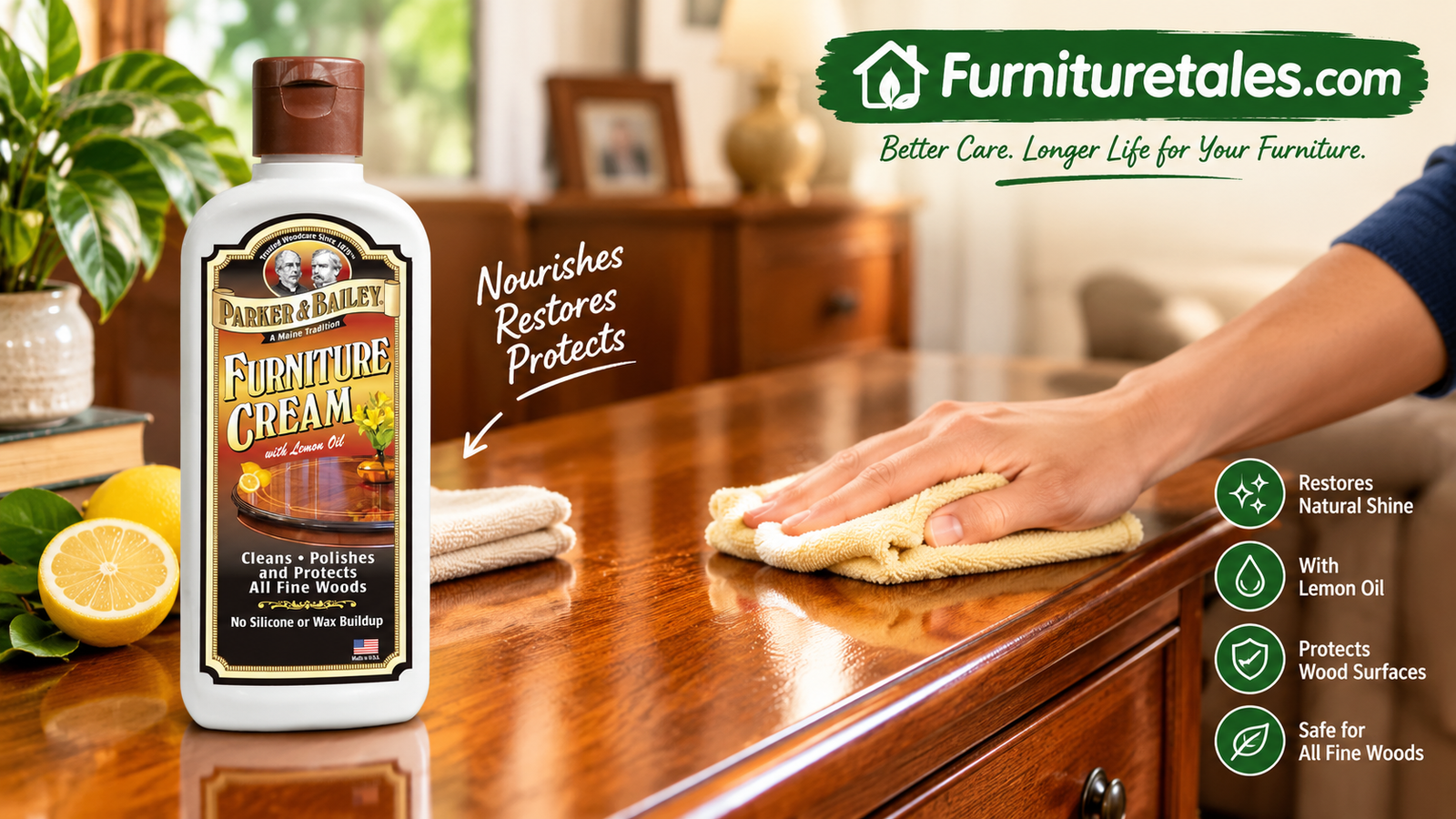
Parker & Bailey Furniture Cream
The controlled, low-mess polish for people who want exactly the right amount of product on exactly the right surface.
Cream polishes occupy a sweet spot between sprays and pastes, and Parker & Bailey has been refining the format for a very long time. You pour or dab a small amount onto a cloth, work it over the surface, and buff lightly. There is no airborne mist to worry about, no thick paste to fight with, and far less risk of over-application. For fine furniture, antiques with delicate details, or rooms filled with fabric, that control matters.
The cream cleans while it shines, lifting light grime and leaving a smooth, even polish behind. It is the kind of product people use on the pieces they notice most — the entry table, the coffee table, the bedroom dresser — where the finish has to look intentional up close. And because the format is so tidy, it is genuinely pleasant to use anywhere in the house.
Key Features
- Cream format gives precise, drip-free, mist-free control
- Cleans and conditions in one thoughtful step
- Long-established furniture care heritage
- Ideal on detailed, delicate, or valuable pieces
- Smooth, even polish without heavy build-up
What We Love
- Best-in-class control over how much product you use
- Zero spray drift — safe around upholstery and rugs
- Beautiful on detailed and high-visibility furniture
- Very tidy, satisfying application experience
Keep in Mind
- Slower than a spray for whole-house sessions
- Lighter protective film than a dedicated paste wax
- Cloth management matters — use clean, soft, lint-free cloths
Make Weekly Upkeep Effortless
Grab an everyday clean-and-polish product and keep every wood surface in your home guest-ready.
Shop Everyday Polish on AmazonPlant-Based & Food-Safe Waxes: Walrus Oil Wood Wax & CLARK’S Cutting Board Wax
Kitchen wood lives a harder life than anything in the living room. Cutting boards take knife scars and daily washing. Butcher blocks host raw ingredients. Serving boards go from oven to table. The waxes in this section are built for that world — formulated with food-contact surfaces in mind and beloved by the woodworking community for their honest, natural finish.
Swipe to see more →
| Feature | Walrus Oil Wood Wax | CLARK’S Cutting Board Wax |
|---|---|---|
| Best for | Live-edge, raw wood, woodworking projects | Cutting boards, butcher blocks, kitchen wood |
| Finish | Satin, natural, grain-forward | Clean, conditioned, protective top layer |
| Appeal | Plant-forward formula makers love | Food-contact focused maintenance |
| Routine | Project finishing and periodic refresh | Regular kitchen reconditioning cycle |
Walrus Oil Wood Wax
A favorite among modern woodworkers who want a plant-forward wax that finishes beautifully and feels good to use.
Walrus Oil built its reputation in the woodworking community, where finish quality is judged at arm’s length under good light and opinions are earned rather than marketed. Its wood wax produces a natural, grain-forward satin look that suits live-edge slabs, raw wood furniture, handmade serving pieces, and anything where you want the material to look like itself — just better.
What makers appreciate most is the balance. The wax adds enough protection for real life without burying the wood under a plastic-looking film. It spreads easily, buffs to an even sheen, and refreshes well over time, which makes it ideal for pieces that get used and loved rather than displayed behind glass. If your aesthetic leans toward the natural and the handmade, this formula fits right in.
Key Features
- Plant-forward wax formula favored by hobby and professional woodworkers
- Natural satin finish that keeps grain looking authentic
- Excellent on live-edge pieces, raw wood, and handmade projects
- Easy wipe-on maintenance and refresh cycle
- Works as a top layer over appropriate oil treatments
What We Love
- Genuinely natural look — no plastic sheen
- Simple, satisfying application on raw and oiled wood
- Well-regarded in the maker community
- Refreshes beautifully as part of ongoing care
Keep in Mind
- Best results usually follow proper oiling or prep
- Not aimed at heavy film finishes like polyurethane
- Natural finishes want more frequent refresh on heavy-use pieces
CLARK’S Cutting Board Wax
Purpose-built for the wood that touches your food — the maintenance layer that keeps boards, blocks, and serving pieces healthy.
Cutting boards are the most abused wood in any home, and they show it: knife scars, cloudiness, dry patches, water staining from washing. CLARK’S Cutting Board Wax is designed as the protective finishing step in a proper board care routine. The wax layer helps seal in conditioning, repels water during use and washing, and keeps the board looking cared for rather than worn out.
For anyone who has invested in good kitchen wood — a beautiful end-grain board, a proper butcher block island, a set of handmade serving boards — this is the product that protects that investment. It is straightforward to use: work it into clean, dry wood, let it settle, then buff away the excess. Boards look richer immediately and stay resilient longer between deep conditioning sessions.
Key Features
- Designed specifically for food-contact wooden surfaces
- Protective wax layer that helps repel water in daily kitchen use
- Popular choice for cutting boards, butcher blocks, and serving pieces
- Simple wipe-on, buff-off maintenance routine
- Pairs with conditioning oils as the final sealing step
What We Love
- Made for exactly the job — no adapting generic products
- Boards look noticeably richer and healthier after use
- Easy routine even for people who neglect kitchen wood
- Pairs perfectly with a conditioning oil cycle
Keep in Mind
- Specialized — not your living room furniture product
- Boards need proper cleaning and drying first
- Heavy-use boards want a fairly regular care rhythm
Give Kitchen Wood the Care It Deserves
Food-safe waxes keep boards, blocks, and serving pieces resilient and beautiful through years of real cooking.
Shop Food-Safe Wood Wax on AmazonHow to Apply Furniture Wax Like a Professional
Here is the secret professionals know that most casual waxers do not: the product is rarely the problem. Application is. A modest wax applied with the right technique will outperform an expensive wax slapped on thick and buffed in a hurry. The good news is that professional technique is easy to learn, and once you have it, every wax in this guide will perform at its best.
Clear and Clean Thoroughly
Remove everything from the surface and wash away dust, grime, old polish residue, and sticky spots. Wax magnifies whatever it covers, so this step decides how clean the final result looks. Dry completely before moving on.
Inspect and Repair First
Deal with scratches, dents, and lost veneer before waxing. Wax hides fine surface marks beautifully but cannot fix structural damage. Handle repairs properly, then let everything cure.
Apply a Thin, Even Coat
Load a soft cloth with a small amount of product — less than feels right — and work in the direction of the grain in manageable sections. Thin coats buff out beautifully; thick coats create haze and sticky spots.
Let It Haze Briefly
Give the wax a short window to set up, exactly as the product directions suggest. This is when the solvents or carriers leave and the wax film stabilizes. Rushing here causes streaking; waiting too long makes buffing harder.
Buff With Clean, Soft Cloths
Switch to a fresh cotton cloth and buff with steady, circular-to-linear strokes until the sheen is even. Rotate to clean cloth faces often. The buffing stage is where the professional look actually appears.
Cure, Then Use Gently
Give the surface a day before heavy use or stacking objects back on it. From then on, dust regularly, coast everything, and plan a light refresh whenever the surface starts looking tired rather than waiting until it looks neglected.
Technique Details That Separate Amateurs from Pros
- Grain direction matters. Always work and buff along the grain. Cross-grain buffing leaves micro-marks that show up under raking light.
- Cloths are consumables. Old, soft cotton t-shirts are perfect. Avoid anything abrasive, printed, or microfiber-shedding on the final buff.
- Work in sections. Do one tabletop quarter at a time rather than coating the whole surface and chasing the haze around the room.
- Temperature and humidity matter. Wax behaves best in a normal room climate. Extreme cold slows drying; extreme heat makes solvents flash too quickly.
- Less is genuinely more. If you can see thick wax on the surface before buffing, you have used too much. Wipe some off and continue.
- Maintain rather than rescue. A light refresh twice a year beats a heroic strip-and-rewax every five years. Maintenance also keeps marks from setting — and when damage does appear, guides like removing water rings and removing scratches from wood furniture are far easier on a well-kept finish.
Protecting the Finish Beyond the Surface
Wax does its best work when the rest of the room cooperates. Felt pads and sliders stop grit from grinding into tabletops and floors every time something moves — our reviews of the best furniture pads for hardwood floors cover the options. Direct sunlight remains the fastest way to fade a beautiful finish, so treat window placement as a furniture care decision. And if you have inherited a piece that smells musty or stale, sort that out before waxing with our guide on how to get smell out of used furniture — sealing in odor is the one thing worse than leaving it alone.
The Professional’s Rule
Clean first, repair second, thin coats always, buff thoroughly, and maintain on a rhythm. Follow that and almost any wax on this list will give you a result you would be happy to photograph.
Get the Right Tools for the Job
Soft cloths, a quality wax, and a little patience. That is the entire professional toolkit.
Shop Furniture Wax on AmazonFurniture Wax vs Polish vs Oil — and the Mistakes to Avoid
The wood care aisle is full of near-synonyms that are not actually synonyms, and mixing them up is the root cause of most disappointing results. Once you understand what each category does, product selection becomes almost automatic.
Wax vs Polish vs Oil: The Real Differences
- Wax lays down a thin, physical barrier on the surface. It protects, softens light reflection, and can be renewed or removed. Think of it as a shield.
- Polish is a broad term that includes everything from conditioning sprays to cream cleaners. Its job is to make the surface look clean, even, and fresh. Think of it as presentation.
- Oil penetrates and conditions the wood itself rather than sitting on top. It feeds dry wood and enriches grain. Think of it as nourishment.
Many of the best modern products blur these lines on purpose. Feed-N-Wax conditions and protects. Cream polishes clean and shine. Food-safe systems typically combine an oil treatment with a wax topcoat. That blending is a feature, not a marketing trick — real furniture care genuinely benefits from doing two things in one session. If you want to see how wax sits alongside the wider world of shine products, our guide to the best furniture polish lays out the full landscape.
Six Mistakes That Ruin Good Furniture
What to Avoid
- Waxing over grime. Dirt becomes a permanent cloudy layer under wax. Clean first, always.
- Using too much product. Thick application causes haze, streaks, and a sticky surface that attracts dust.
- Buffing too soon or too late. Follow the product’s timing guidance for haze and buffing — it exists for a reason.
- Mixing incompatible products. Silicone-heavy polishes can interfere with later refinishing. Choose products deliberately.
- Ignoring the environment. Sun, heat vents, and dry air do more damage than daily use ever will.
- Skipping protection around the piece. Bare feet, sliding chairs, and dragged decor scuff both furniture and floors. Felt pads and sliders solve this — see the best furniture sliders for hardwood floors.
What to Do Instead
- Clean first, then wax. A proper wash and dry makes every wax perform better.
- Thin coats, always. Build sheen with layers and buffing rather than volume.
- Set a simple rhythm. Light monthly upkeep, deeper wax treatment seasonally.
- Choose products that match. Conditioning for dry wood, paste for protection, spray for upkeep, food-safe for kitchens.
- Manage light and climate. Rotate pieces if a surface is taking direct sun, and keep rooms at sane humidity.
- Use coasters and pads religiously. Prevention is dramatically easier than repair.
When Wax Is Not the Answer
Be honest about the damage before you reach for a tin. Deep gouges, peeling finish, water damage that has raised the grain, structural cracks, and active mold all need proper repair rather than a shine layer. In those cases, start with repair products and techniques, then finish with wax once the surface is sound. And if the piece is simply positioned badly — squeezed against a radiator or blasted by afternoon sun — fix the placement before anything else.
Match the Product to the Problem
Now that you know exactly which category your furniture needs, pick your formula and get that surface glowing again.
Check Price on AmazonReader Questions
Frequently Asked Questions About Furniture Wax
Is furniture wax safe for all wood finishes?
Wax is safe and effective on most cured film finishes — polyurethane, lacquer, varnish, shellac, and many painted surfaces — as well as on raw and oil-finished wood. The key word is cured. Never wax a finish that is still drying or gassing off, and always test in a hidden area first if the piece is old, unusual, or unfamiliar.
How often should I wax wood furniture?
For most homes, a deeper wax treatment every few months is plenty, with lighter upkeep like dusting and quick polishing in between. High-use surfaces such as dining tables may want more frequent attention, while display pieces can go much longer. Watch the wood rather than the calendar: when it starts looking dry, dull, or less even, it is time.
Can I wax over a polyurethane finish?
Yes, once the polyurethane is fully cured. Wax over a hard topcoat adds a sacrificial protective layer that takes the brunt of daily contact and can be refreshed without touching the finish underneath. This is one of the smartest things you can do for a dining table or desk.
What is the difference between paste wax and liquid polish?
Paste wax is a thicker product applied in thin coats and buffed, creating a more durable protective film with a hand-rubbed look. Liquid and spray polishes are faster and better for frequent cleaning and shine, but their protective layer is lighter. Many households use both: polish for weekly upkeep, paste wax for seasonal protection.
Will wax make my furniture look shiny or greasy?
Applied correctly — thin coat, proper buffing — wax produces a soft, natural sheen, not a greasy glare. If furniture looks wet or sticky afterward, the cause is almost always over-application. Wipe the surface with a clean cloth to remove the excess and buff again; it will settle into an even finish.
Can I use furniture wax on kitchen cutting boards or countertops?
Only with products specifically designed and labeled for food-contact surfaces. General furniture waxes and polishes are not intended for food-prep areas. For boards and butcher blocks, choose a dedicated food-safe wood wax and follow its care instructions exactly.
Does wax protect against water rings and heat marks?
Wax meaningfully improves resistance to moisture and gives you time to wipe spills before they penetrate, which prevents many rings from ever forming. However, it is not a force field. Prolonged contact with cold glasses or hot dishes can still leave marks on any finish, so keep using coasters and trivets even on freshly waxed surfaces.
Can I wax painted furniture?
Absolutely, provided the paint has fully cured and the wax is compatible with painted surfaces. Clear finishing waxes are the safest bet because they protect without shifting color. Always test on a hidden spot first, especially with dark or matte paints where any haze would be more visible.
How do I remove old wax build-up from wood furniture?
Start with a thorough cleaning using a wood-safe cleaner and warm, barely damp cloths, repeating until the residue is gone. In stubborn cases, a dedicated wax-removing approach may be needed. Once clean and dry, you can reapply a fresh, thin coat for an even appearance without cloudy layers.
Is wax better than oil for old, dry wood?
They solve slightly different problems. Oil penetrates and nourishes thirsty wood from within, while wax protects and beautifies the surface. For badly dried pieces, conditioning first and then protecting with wax is the ideal sequence — which is exactly why hybrid products that combine both have become so popular.
Can I wax furniture that has a silicone-based polish on it?
You can, but results may be uneven and there is a bigger long-term consideration: silicone contamination can complicate future refinishing. If you plan to strip or refinish the piece someday, avoid silicone-heavy products now and stick with wax-based or oil-based care.
Do I need to wax new furniture?
Most new furniture arrives with a durable factory finish that does not immediately need waxing. Give it a few months of normal life, then consider a light wax treatment to add a protective, easy-clean layer — especially on dining and coffee tables that see daily contact.
Still Deciding?
Browse the full selection of furniture waxes on Amazon and compare formulas, formats, and sizes side by side.
Shop Furniture Wax on AmazonFinal Verdict
The Best Furniture Wax Is the One You Will Actually Use
After working through all eleven formulas, the pattern is clear. There is no single universal winner, but there are excellent winners for specific situations. Howard Feed-N-Wax earns our overall top spot because it handles conditioning and protection in one forgiving step, which is exactly what most households need. Minwax Paste Finishing Wax is the reliable, classic choice for sealing and beautifying finished projects. Renaissance Wax is the answer when the piece is irreplaceable and preservation is everything.
Beyond those, match the product to your reality. Choose a spray like The Original Bee’s Wax or Guardsman for fast weekly upkeep. Choose a cream like Parker & Bailey when control matters. Choose Briwax or Goddard’s when you love the traditional finishing ritual. Choose Dixie Belle for painted projects, and reach for Walrus Oil or CLARK’S when the wood lives in the kitchen.
Whichever tin you open first, remember the golden rules: clean before you wax, apply thin, buff patiently, and protect the surface from sun, water, and sliding grit. Do that, and your wood furniture will look better in five years than it does today — which is the whole point.
Keep Reading
You May Also Like
More practical guides to keeping every piece of furniture in your home looking its absolute best.
Best Furniture Covers for Outdoor Patio
Weatherproof protection for the furniture that lives outside through every season.
Read the guide → Buyer’s GuideBest Furniture Sliders for Hardwood Floors
Move heavy pieces without scuffing floors or straining your back.
Read the guide → How-ToHow to Paint Furniture
From prep to topcoat, the complete process for a professional-looking finish.
Read the guide → How-ToHow to Paint IKEA Furniture
Make flat-pack pieces look custom with the right primer, paint, and patience.
Read the guide → PlanningWhen Is the Best Time to Buy Furniture
Timing your purchases to catch the strongest selection and value.
Read the guide → DesignHow to Arrange Living Room Furniture
Layout strategies that make any living room feel intentional and inviting.
Read the guide → PlanningHow to Measure Room for Furniture
Get the dimensions right before you order and avoid costly return headaches.
Read the guide → Buyer’s GuideBest Furniture Polish
The full landscape of shine products, compared and ranked for every finish.
Read the guide → How-ToHow to Stop Cats from Scratching Furniture
Humane, effective strategies to save your upholstery and keep the peace.
Read the guide →
Ready to Wax?
Our top pick conditions, polishes, and protects in one easy step — the perfect place to start your furniture care routine.
Check Price on Amazon