
Introduction
Why Wood Filler Is the Most Underrated Product in Furniture Repair
Solid wood furniture ages beautifully right up until the moment it doesn’t. One dropped mug leaves a dent in the dining table. A dresser gets dragged across a doorway and sheds a corner. A toddler discovers that a screwdriver makes an excellent engraving tool. Suddenly that heirloom-quality finish has a blemish the size of a coin, and you are standing in a hardware aisle trying to work out whether you need “wood filler,” “wood putty,” “grain filler,” or a two-part epoxy that looks like it belongs in an auto body shop.
Here is the encouraging news: most furniture damage is genuinely repairable, and the repair is usually invisible if you match the filler to the job. The catch is that wood fillers are not interchangeable. A lightweight water-based filler that disappears under paint will behave badly under a clear stain. A hard-setting epoxy that anchors a rebuilt chair leg will look like chewing gum if you smear it into a shallow scratch on a walnut tabletop. Choosing correctly is eighty percent of the result.
That is exactly what this guide is for. We break down how the major filler chemistries behave — water-based, latex, solvent-based, grain fillers, repair kits, and epoxy putties — then walk through fourteen of the most popular products for furniture repair, one by one. For each one you get the honest use case, the features that matter, the trade-offs worth knowing before you open the tub, and a direct link to check current pricing.
Whether you are rescuing a thrifted dresser, patching a family dining table, or fixing the damage that comes with living alongside pets and kids, the goal is the same: a repair that blends so well nobody asks about it. Let us get you there.

Repair kits bundle filler, colorants, and tools so a single purchase covers everything from a scratch to a filled corner.
Quick Comparison: Our Top Picks
Swipe to see more →
| # | Product | Key Specs | Verdict | Check Price | |
|---|---|---|---|---|---|
| 1 |  |
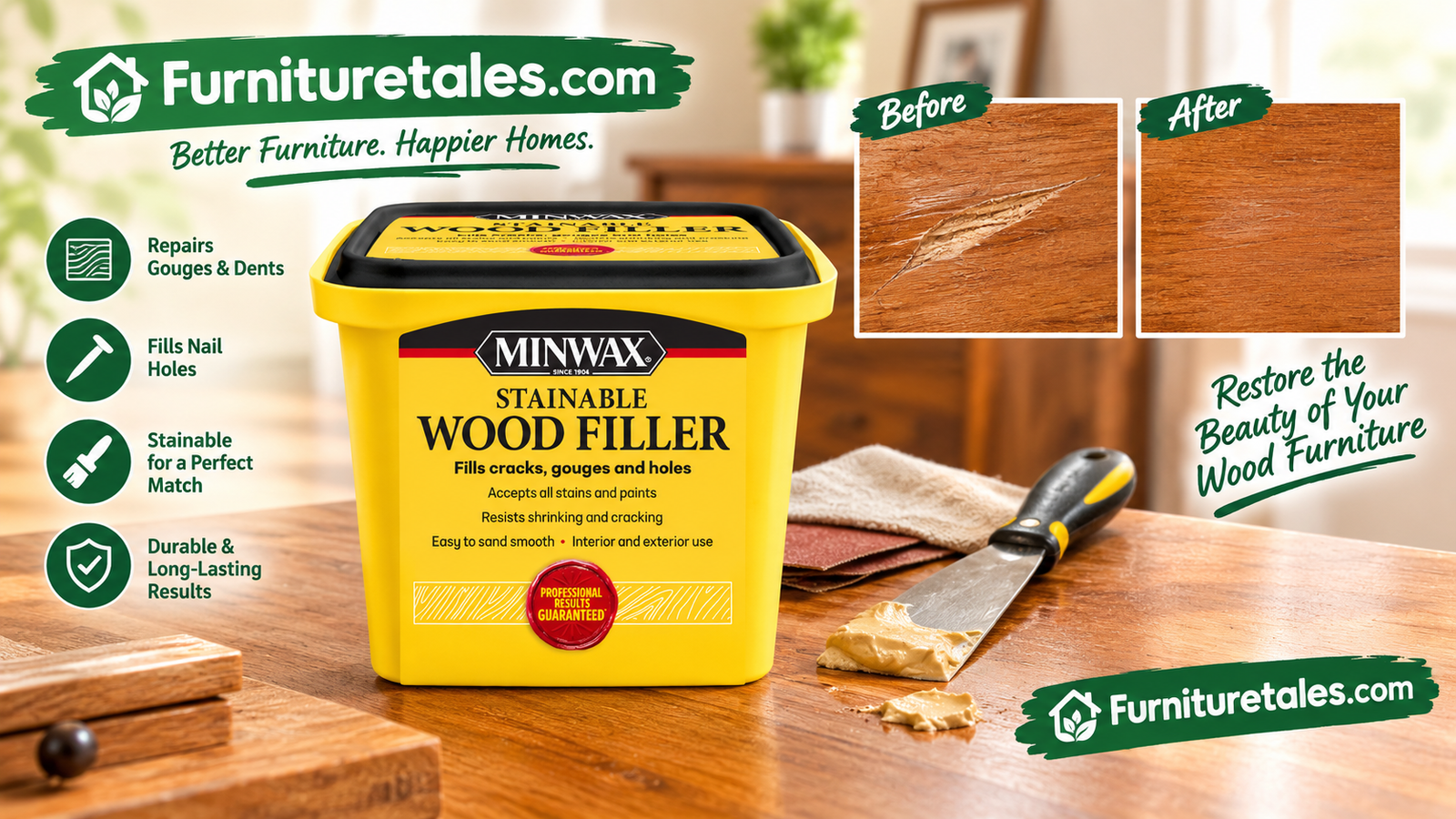
Top Pick Minwax Stainable Wood Filler Best Overall for Stainable Repairs | Type: Water-based · Stainable: Yes · Best for: Nail holes, dents, gouges · Cleanup: Soap and water | Accepts stain far more predictably than most fillers, which is why it is the default choice for visible repairs under clear coats. | Check Price on Amazon |
| 2 |  |
Elmer’s Stainable Wood Filler Best for Small Indoor Touch-Ups | Type: Water-based · Stainable: Yes · Best for: Pinholes, tiny dings · Cleanup: Soap and water | Easy to find, easy to sand, easy to clean up — the fuss-free option for quick repairs on painted or stained pieces. | Check Price on Amazon |
| 3 |  |
FamoWood Latex Wood Filler Best Fast-Drying Latex | Type: Latex-based · Stainable: Yes · Best for: Cracks and moderate voids · Cleanup: Water | Dries quickly, sands to a crisp edge, and holds detail well in trimmed repairs. | Check Price on Amazon |
| 4 |  |
Aqua Coat Clear Wood Grain Filler Best for Open-Grain Woods | Type: Water-based grain filler · Tint: Clear · Best for: Oak, ash, mahogany pores · Cleanup: Water | The specialist for smoothing open grain before staining — clear formula keeps the wood’s color honest. | Check Price on Amazon |
| 5 |  |
Goodfilla Water-Based Wood & Grain Filler Best Pro-Grade Water-Based | Type: Water-based · Stainable: Yes · Best for: Grain filling and repairs · Cleanup: Water | Loved by finishers for its spread, adhesion, and ability to be tinted toward a target tone. | Check Price on Amazon |
| 6 | |
Coconix Floor and Furniture Repair Kit Best Color-Matching Kit | Type: Repair kit · Colorants: Included · Best for: Scratches on finished surfaces · Cleanup: Water | Turns “I can see the scratch” into “where was it again?” on finished, colored surfaces. | Check Price on Amazon |
| 7 |  |
Timbermate Water-Based Wood Filler Best Stainable Water-Based | Type: Water-based · Stainable: Yes · Best for: Tone-matched patches · Cleanup: Water | Shrink-resistant and blendable — a favorite among people who patch, then stain. | Check Price on Amazon |
| 8 |  |
Bondo Wood Repair Putty Best for Large Structural Fills | Type: Two-part repair putty · Stainable: No · Best for: Rebuilt corners, big voids · Finish: Paint preferred | Cures hard and fast, shapes like clay, and does not shrink into the hole you just filled. | Check Price on Amazon |
| 9 |  |
PC Products PC-Woody Two-Part Epoxy Paste Best Two-Part Epoxy Paste | Type: Two-part epoxy · Stainable: No · Best for: Structural repairs, rebuilds · Strength: High | Bonds, fills, and rebuilds in one step — when the repair needs to actually hold weight. | Check Price on Amazon |
| 10 |  |
Abatron WoodEpox Epoxy Wood Replacement Compound Best for Deep Damage & Rot | Type: Epoxy compound · Stainable: Limited · Best for: Deep voids, missing wood · Strength: Very high | Replaces missing wood rather than just filling a hole — the heavy artillery of furniture repair. | Check Price on Amazon |
| 11 |  |
J-B Weld KwikWood Epoxy Putty Stick Best Epoxy Putty Stick | Type: Epoxy putty stick · Stainable: No · Best for: Hardware holes, small rebuilds · Work time: Short | Knead, press, sculpt — no mixing cups, no mess, and it holds threads and hardware. | Check Price on Amazon |
| 12 |  |
DAP Plastic Wood Filler Best Classic All-Rounder | Type: Solvent/latex-based · Stainable: Varies by line · Best for: General indoor repairs · Cleanup: Water or solvent | The hardware-store classic — readily available, sandable, and versatile across everyday fixes. | Check Price on Amazon |
| 13 |  |
REALINN Wood Furniture Repair Kit (28 pc) Best All-in-One Repair Kit | Type: Repair kit (28 pc) · Contents: Fillers, colorants, tools · Best for: Multi-surface touch-ups · Skill: Beginner-friendly | Everything in one box for homes with lots of different finishes to maintain. | Check Price on Amazon |
| 14 |  |
BONCART Paintable Wood Filler Best Paintable Budget Filler | Type: Water-based · Stainable: No · Best for: Painted furniture · Cleanup: Water | Straightforward, smooth, and built for projects where paint does the hiding. | Check Price on Amazon |
Ready to start repairing? Browse the full range of wood fillers, putties, and repair kits on Amazon and compare current options side by side.
Shop Wood Fillers on AmazonSection 01
Why the Right Wood Filler Makes or Breaks a Furniture Repair
Most disappointing furniture repairs fail for the same reason: the filler was asked to do a job it was never designed for. A soft, flexible filler gets used where a rigid structural rebuild was needed. A paint-only filler gets stained and turns a shade darker than the surrounding wood. A fast-setting putty gets mixed in bulk and hardens before it reaches the hole. None of these are product failures in the abstract — they are mismatches.
Wood moves. It expands in humid weather, contracts in dry heat, and flexes under load. A repair that ignores that reality will telegraph itself over time as a hairline crack or a sunken patch. The right filler for the right substrate and the right finish is what keeps a repair invisible a year later, not just on the day you make it.
The Four Failures Worth Preventing
- Color mismatch. Filler does not accept stain exactly like wood. Even “stainable” fillers usually take stain slightly differently, which is why experienced repairers tint the filler itself rather than relying on the stain alone. If the piece is finished already, a color-matching kit is usually smarter than a raw filler.
- Shrinkage. Water-based fillers lose water as they cure, which means a hole filled flush today may be slightly hollow tomorrow. The fix is simple: overfill a touch and sand back once fully dry, or plan on a second thin pass.
- Poor adhesion. Filler stuck to dust, wax, or a glossy finish is filler waiting to fall out. Sand the area, clean away the residue, and give the filler a properly prepared surface to grip.
- Wrong hardness. A corner that takes daily impact needs a hard, durable compound. A hairline scratch on a finished dresser needs a flexible, feather-edged product. Using the wrong one means redoing the repair.
There is also a preventative angle worth mentioning. A huge share of furniture damage is avoidable: felt pads under legs, sliders when rearranging a room, sensible placement away from direct sun and heat vents. If you are fighting recurring scuffs and scrapes, pair your repair kit with good protection habits — our guides to the best furniture pads for hardwood floors and furniture sliders for hardwood floors cover exactly that.
And if the damage is already done — scratches across a tabletop, a ring left by a cold glass, claw marks from an enthusiastic dog — start with the lightest intervention first. Many surface scratches need only a polish or wax rather than a filled repair. We walk through the escalation ladder in how to remove scratches from wood furniture and how to remove water rings from wood furniture. If you live with pets, how to stop cats from scratching furniture is worth a read before you spend an afternoon filling claw grooves.
What a Good Repair Actually Looks Like
A successful filler repair is boring, which is the highest compliment. The patched area sits dead flush with the surrounding surface, holds its edge after sanding, accepts color at the same depth as the wood, and shows no outline when the light rakes across it. Achieving that comes down to three habits: clean preparation, thin build-up in layers, and patient sanding with a sanding block rather than bare fingertips.
Keep those habits in mind as we move through the products. The fillers below span every chemistry and price point, and the honest truth is that most of them are excellent at their intended job. The skill is in the matching.
Prevent the next repair. Grab felt pads, sliders, and protective supplies so the filler you buy today is the last one you need for a while.
Browse Furniture Protection on AmazonSection 02
Types of Wood Filler — and How to Choose the Right One
Walk into any paint or hardware store and the filler aisle looks chaotic: tubs, tubes, sticks, syringes, two-part tins, and pouches, all labeled with overlapping terms. Cut through the noise and there are six broad categories, each with a distinct personality. Once you can name the category, choosing becomes easy.
1. Water-Based Wood Fillers
These are the everyday workhorses. They spread smoothly, clean up with soap and water, dry relatively quickly, and sand easily. Many are formulated to accept stain, though the degree varies. Water-based fillers are ideal for nail holes, dents, small gouges, and shallow cracks on indoor furniture. Their one known trait is mild shrinkage in wider fills, solved by overfilling slightly.
2. Latex-Based Fillers
Latex fillers trade a little hardness for flexibility and easy handling. They tend to feather out nicely at the edges and are forgiving for beginners, which makes them popular for trim work and everyday furniture touch-ups. They clean up with water and generally sand to a smooth finish without gumming up the paper.
3. Solvent-Based / “Plastic Wood” Fillers
The classic hardware-store tubs often contain real wood fibers and dry hard, closer to the feel of wood itself. They hold screws and nails better than lightweight fillers and can be sawn and planed once cured. The trade-offs are stronger odor, solvent cleanup, and a tendency to show color variation under stain unless you select a stainable version and test first.
4. Grain Fillers
Grain fillers are not patching compounds — they are surface-preparation products. Open-pored woods like oak, ash, and mahogany have deep pores that telegraph through paint and stain. Grain filler is spread across the whole surface to level those pores, then wiped and sanded for a glass-smooth base. Clear versions preserve the wood’s natural tone; tinted versions can deepen or shift the color deliberately.
5. Two-Part Epoxy Compounds
When wood is missing entirely — a rotted chair leg, a corner torn away, a stripped screw hole in a hinge stile — epoxy is the answer. Mixed from two components, these cure into a hard, durable mass that bonds tenaciously and can be carved, sanded, drilled, and painted. They are overkill for a scratch and indispensable for structural rebuilds.
6. Repair Kits and Color-Match Systems
Kits bundle a small amount of filler or putty with colorants, applicators, and blending tools. They are designed for finished surfaces where the goal is camouflage rather than refinishing. If the piece stays finished and you want to fix scratches and chips without stripping anything, this is the category to shop.
Swipe to see more →
| Filler Type | Best For | Stainable? | Keep In Mind |
|---|---|---|---|
| Water-based | Nail holes, dents, small gouges | Often, varies by formula | May shrink slightly in deep fills; overfill and sand |
| Latex-based | Trim, cracks, beginner repairs | Usually yes | Flexible and forgiving; slightly softer cure |
| Solvent-based | Hard-wearing general repairs | Some lines, test first | Stronger odor; solvent cleanup |
| Grain filler | Open-pore woods before finishing | Clear versions preserve tone | Whole-surface product, not a patching compound |
| Two-part epoxy | Structural rebuilds, missing wood | Generally no | Best painted; unstoppable bond and strength |
| Repair kits | Finished surfaces, color camouflage | Not applicable | Color-matching skill matters more than the product |
How to Choose: Five Questions to Ask Before You Buy
- What finish will cover the repair? Clear coats need a stainable, tone-matched filler. Paint hides a great deal and lets you choose for durability instead of looks.
- How deep is the damage? Shallow scratches and pinholes suit lightweight fillers. Deep voids and missing wood demand epoxy or a hard-curing repair putty.
- Is the repair structural? Anything that holds weight, hardware, or a joint needs bonding strength, not just a filled appearance.
- Indoor or outdoor? Outdoor furniture needs a compound that tolerates moisture and temperature swings. Check the label for exterior suitability before committing.
- How much finishing will you do? If you plan to sand and recoat the entire surface, filler choice is flexible. If you are patching into an existing finish, color-matching kits win.
One more consideration: your project’s paint compatibility. If the piece is due for a fresh coat anyway, matching the filler to the paint is simple, and our roundup of the best paint for furniture pairs perfectly with the fillers reviewed below.
Compare the categories side by side. Filter by water-based, epoxy, or repair kit and see what is available right now.
Explore Filler Types on AmazonSection 03
Product Reviews: The Fillers That Earn Their Keep
With the chemistry sorted out, it is time for the products themselves. Each review below focuses on behavior rather than brochure claims: how the filler spreads, how it finishes, and the specific job it does best.
Top Pick · Stainable Water-Based
Minwax Stainable Wood Filler
Minwax has been in the wood-finishing world long enough that its stainable filler has become the mental default for anyone repairing furniture that will see a clear coat. The pitch is straightforward and it delivers on it: fill the damage, sand it flush, then apply stain and topcoat without the repair showing up as a pale or dark blotch.
What sets it apart is predictability. Plenty of fillers claim to be stainable; this one behaves close enough to the surrounding wood that most users get a blend they are happy with on the first attempt. That makes it the right starting point for a dining table, a dresser top, or any surface where the finish is meant to look like wood, not like a painted patch.
Key Features
- Formulated to accept wood stain alongside the surrounding grain
- Water-based formula cleans up easily with soap and water
- Sands smooth and holds a crisp edge around nail holes and gouges
- Suitable for common furniture repairs: dents, dings, small voids, and pulled fastener holes
- Works under both stain-and-clear systems and painted finishes
Pros
- Blends convincingly under stain compared to generic fillers
- Easy sanding without gumming up sandpaper
- Low-fuss cleanup with water
- Versatile across painted and stained projects
Cons
- Wide, deep fills may need a second pass after drying
- Not intended for structural or load-bearing repairs
- Color match is good, not magic — test on scrap first
Who it is best for: Anyone repairing furniture that will be stained and clear-coated. If you want one tub to sit in the garage for the next decade of dents and dings, this is the one to buy first.
Check Price on AmazonSection 04
Elmer’s Stainable Wood Filler — The Easy Everyday Touch-Up
Best for Small Indoor Touch-Ups
Elmer’s Stainable Wood Filler
Elmer’s has been the friendly face of household adhesives and fillers for generations, and its stainable wood filler fits that mold: approachable, forgiving, and available almost everywhere. This is the tub you reach for when a nightstand has a handful of pinholes, a bookshelf has a corner ding, or a thrifted frame needs a few minutes of attention before it earns a spot in the living room.
It spreads easily with a putty knife, sands without much fuss, and cleans up with water, which lowers the barrier for anyone who has never done a repair before. On stained pieces it does accept color, though as with any filler, a test patch on an inconspicuous area will tell you exactly how it reads against your wood tone.
Key Features
- Water-based and low-hassle to apply and clean up
- Formulated to take stain along with the surrounding wood
- Sands easily for a flush finish
- Well suited to small holes, dents, and minor surface damage
- Beginner-friendly consistency that stays workable while you smooth it
Pros
- Extremely easy to find and easy to use
- Water cleanup, no special solvents needed
- Good choice for quick, small repairs
- Forgiving for first-time repairers
Cons
- Not the pick for large structural fills
- Like most water-based fillers, deep applications can shrink slightly
- Stain take-up may differ on very dark woods — test first
Who it is best for: Homeowners and renters handling routine indoor touch-ups. If your repair list is a page of small marks rather than a single dramatic hole, this filler keeps things simple and low-cost.
Check Price on AmazonSmall repairs, big difference. Keep a tub of stainable filler on hand and stop letting pinholes and dings accumulate on your favorite pieces.
Shop Stainable Fillers on AmazonSection 05
The Paintable Workhorses: DAP Plastic Wood & BONCART
Not every repair needs to disappear under stain. If the piece is painted, or will be by the time you are done, your priorities change: adhesion, sandability, and a smooth feathered edge matter far more than tone matching. These two products are built for exactly that job, and they take slightly different routes to get there.
Swipe to see more →
| Product | Best For | Finish Plan | Standout Trait |
|---|---|---|---|
| DAP Plastic Wood Filler | Everyday indoor repairs | Paint or stain (select lines) | Hard, wood-like cure that can be sanded, sawn, and shaped |
| BONCART Paintable Wood Filler | Painted furniture projects | Paint | Smooth, spreadable consistency designed to disappear under paint |
Best Classic All-Rounder
DAP Plastic Wood Filler
Ask a hardware store clerk for “wood filler” and there is a good chance this is what gets handed to you. DAP’s Plastic Wood line has earned that position by doing the ordinary jobs reliably: filling holes, rebuilding small chips, and drying to a hard, workable surface that behaves enough like wood to be sanded and trimmed.
It is a genuinely versatile product. The cured material is hard enough to hold an edge and accept shaping, which makes it more capable than soft lightweight fillers on chipped corners and worn edges. On paint-grade work it excels. On stained work, check the specific product line — some variants are formulated for stain, and a quick test always beats a guess.
Key Features
- Hard, wood-like cure suitable for chips, holes, and edge damage
- Sands, shapes, and can be trimmed once cured
- Widely available and well proven across decades of household repairs
- Multiple formulations exist for different finishes and applications
- Good everyday choice for indoor furniture and trim
Pros
- Hard-wearing finish that handles daily use
- Excellent for chipped corners and worn edges
- Easy to source locally and online
- Sands to a clean, featherable edge
Cons
- Some formulas carry noticeable odor — ventilate
- Stain results vary by line; testing is essential
- Fast-set versions can demand quick, confident application
Who it is best for: Generalists. If you want a single product that handles painted repairs, corner rebuilds, and everyday holes without a special trip, this is the pragmatic pick.
Check Price on Amazon
Best Paintable Budget Filler
BONCART Paintable Wood Filler
BONCART keeps things uncomplicated on purpose. This is a water-based, paintable filler aimed squarely at people who are working on painted furniture: dressers being flipped, cabinets being refreshed, shelves getting a new color. The formula spreads smoothly, takes paint evenly, and sands back without drama.
What makes it appealing for project work is consistency. It behaves predictably across a full piece of furniture, which matters when you are filling a long row of hardware holes and want them all to look identical under the new coat. For a paint-first workflow — prime, fill, sand, paint — it slots in cleanly.
Key Features
- Water-based, paintable formula with smooth spreadability
- Sands to an even surface for a seamless painted finish
- Designed for furniture repair and refinishing projects
- Simple water cleanup keeps the workflow tidy
- Good for filling hardware holes, gouges, and edge wear
Pros
- Excellent under paint — takes color evenly
- Easy to work with across large projects
- Water-based and low-fuss to clean up
- Strong value for paint-grade furniture work
Cons
- Not the choice for stain-first finishes
- Deep fills may need layered application
- Less suited to structural repairs
Who it is best for: Furniture flippers, DIY painters, and anyone whose repair ends under a coat of paint rather than a clear finish.
Check Price on AmazonPlanning a paint job? Match your filler to your coating and finish the project in one pass — then see our step-by-step painting guide for the rest.
Shop Paintable Fillers on AmazonSection 06
FamoWood Latex Wood Filler — Fast, Smooth, and Forgiving
Best Fast-Drying Latex
FamoWood Latex Wood Filler
There is a particular satisfaction in a filler that dries quickly, sands crisply, and lets you keep moving. FamoWood’s latex-based filler is built for that rhythm. It goes on smoothly, holds its shape in cracks and voids, and cures fast enough that a repair session does not eat an entire afternoon.
Latex formulas also tend to feather beautifully at the edges, which is a real advantage on visible surfaces. A repair that transitions imperceptibly into the surrounding wood is what separates a professional-looking fix from an obvious patch, and that feathering quality is where this product shines.
Key Features
- Latex-based formula with quick drying behavior
- Smooth, spreadable consistency for cracks and moderate voids
- Sands cleanly and feathers well at repair edges
- Water cleanup for an easy workflow
- Well suited to trim, frames, and everyday furniture repair
Pros
- Dries quickly so projects keep moving
- Beautiful feathered edges on visible surfaces
- Sands without clogging paper
- Beginner-friendly consistency
Cons
- Not designed for structural or high-load repairs
- Quick drying means limited reworking time
- Deep holes may require staged fills
Who it is best for: Anyone who values speed and clean feathered edges — especially useful on trim, frames, and furniture where the repair is visible but not structural.
Check Price on AmazonWorking on trim and detail pieces? A fast-drying latex filler keeps your repair session efficient and your edges invisible.
Check Latex Filler Options on AmazonSection 07
Aqua Coat Clear Wood Grain Filler — The Open-Grain Specialist
Best for Open-Grain Woods
Aqua Coat Clear Wood Grain Filler
Here is the product that confuses people most, because it solves a different problem than the rest of this list. Aqua Coat is a grain filler, not a hole filler. Its job is to settle into the open pores of woods like oak, ash, and mahogany and level the surface before finishing, so paint lays down glass-smooth and stain reads evenly instead of pooling in the grain.
The clear formula is the point. It fills the pores without significantly shifting the wood’s color, which is exactly what you want when the goal is to keep the timber looking like itself while eliminating that coarse, textured feel. For furniture with visible open grain, this is the difference between a finish that looks homemade and one that looks manufactured in the best way.
Key Features
- Clear water-based grain filler that preserves natural wood tone
- Levels open pores in oak, ash, mahogany, and similar species
- Creates a smooth base for paint, stain, and topcoats
- Water cleanup with straightforward application and wipe-back
- Useful for both furniture refinishing and new-finish preparation
Pros
- Delivers genuinely smooth, professional-feeling surfaces
- Clear formula keeps the wood’s color honest
- Dramatically improves painted finishes on open-grain species
- Easy water-based cleanup
Cons
- Not a patching product — won’t fix gouges or holes
- Whole-surface work takes patience on large pieces
- Less impactful on tight-grain woods like maple or cherry
Who it is best for: Anyone finishing open-grain furniture, especially painters chasing a smooth factory-like surface. If your oak dresser feels rough under a fresh coat, this is the missing step — pair it with the techniques in how to paint IKEA furniture for an especially polished result on laminated and veneered pieces.
Check Price on AmazonChasing a glass-smooth finish? Grain filler is the secret step most people skip — and the one that makes the biggest visible difference.
Shop Grain Fillers on AmazonSection 08
The Pro Water-Based Pair: Goodfilla & Timbermate
Among people who finish furniture for a living, two water-based fillers come up again and again. Both spread well, both sand beautifully, and both reward a careful hand. Where they differ is in emphasis: one leans toward versatile grain filling and tinting flexibility, the other toward shrink-resistant patching that takes stain cleanly.
Swipe to see more →
| Product | Best For | Stainable | Standout Trait |
|---|---|---|---|
| Goodfilla Water-Based Wood & Grain Filler | Grain filling and tinted repairs | Yes | Versatile consistency that spreads thin or builds up as needed |
| Timbermate Water-Based Wood Filler | Tone-matched patches under stain | Yes | Shrink-resistant behavior that holds its place while curing |
Best Pro-Grade Water-Based
Goodfilla Water-Based Wood & Grain Filler
Goodfilla occupies the space between a repair filler and a finishing product. Its consistency is the headline feature: it spreads thin and level when you are filling grain across a tabletop, yet builds up confidently when you are patching a genuine void. That versatility is why it turns up in professional shops where one product needs to cover several jobs.
It also plays nicely with color work. Finishers appreciate being able to nudge the filler toward a target tone before application, which is the single most reliable way to make a patch vanish under stain. Whether you use that capability or simply rely on its stainable formula, the result is the same: repairs that respect the surrounding wood.
Key Features
- Water-based formula that serves as both grain filler and repair filler
- Stainable, and receptive to tinting toward a target tone
- Spreads thin for grain work or builds up for deeper fills
- Sands smoothly to a professional-grade surface
- Water cleanup for a simple, low-odor workflow
Pros
- Exceptional spread and workability
- Doubles as grain filler and patching compound
- Tinting flexibility helps repairs disappear
- Easy cleanup and sanding
Cons
- Not a structural repair product
- Tinting adds a step for best results
- Large-surface grain work is labor-intensive by nature
Who it is best for: Serious DIYers and refinishers who want one capable water-based product for both grain filling and repairs, and who are willing to tint for perfect matches.
Check Price on Amazon
Best Stainable Water-Based
Timbermate Water-Based Wood Filler
Timbermate has a loyal following for one very specific reason: it tends to stay where you put it. Shrinkage is the nemesis of water-based fillers, and Timbermate’s formulation is well regarded for holding its shape while curing, which means fewer second passes and less sanding back sunken patches.
It also takes stain well, making it a natural choice for the patch-then-stain workflow that most furniture repair involves. For tone-matched work on a dining table, a dresser, or a set of chairs, that combination of shrink resistance and stain acceptance is genuinely valuable.
Key Features
- Water-based filler with strong resistance to shrinkage
- Formulated to accept stain alongside natural wood
- Smooth consistency that spreads and feathers well
- Water cleanup and straightforward sanding
- Suited to both small patches and moderate fills
Pros
- Holds its place while curing — fewer repeat fills
- Reliable stain take-up for tone-matched repairs
- Sands to a clean, flush surface
- Low-fuss water-based cleanup
Cons
- Not intended for structural repairs
- Very large fills still benefit from layering
- Stain matching still calls for a test patch
Who it is best for: Anyone patching, then staining. If your repair sits under a clear finish and you want the filler to stay put and take color predictably, Timbermate deserves a look.
Check Price on AmazonSerious about invisible patches? A high-quality stainable filler is the foundation of any repair that ends under a clear coat.
Shop Pro-Grade Fillers on AmazonSection 09
All-in-One Repair Kits: Coconix & REALINN
When the furniture is already finished and staying that way, filler alone is only half the solution — color is the other half. Repair kits exist precisely for this scenario, bundling compounds, colorants, and applicators so a scratch or chip can be camouflaged rather than refinished. For households with a mix of wood tones and finishes, they are remarkably practical.
Swipe to see more →
| Product | Best For | Format | Standout Trait |
|---|---|---|---|
| Coconix Floor and Furniture Repair Kit | Color-matching finished surfaces | Kit with colorants | Camouflage approach that hides damage without refinishing |
| REALINN Wood Furniture Repair Kit (28 pc) | Multi-surface household repairs | 28-piece kit with tools | Comprehensive selection for many different finishes in one box |
Best Color-Matching Kit
Coconix Floor and Furniture Repair Kit
Coconix approaches furniture damage from a different angle than a tub of filler. Instead of preparing you to refinish, it prepares you to camouflage: fill the scratch, blend the color, and walk away with the damage effectively erased on a finished surface. For floors, tabletops, cabinet doors, and anything else that already has a coat you like, that is the fastest path to a good result.
The strength of the system is color flexibility. Working with colorants rather than relying on a pre-mixed shade means you can nudge toward the exact tone of your piece, which is what makes a repair truly invisible rather than merely filled. Patience with blending is the main skill involved — and the results reward it.
Key Features
- Repair kit designed for floors and furniture on finished surfaces
- Color-matching approach blends repairs into existing finishes
- Covers scratches, chips, and small gouges without full refinishing
- Includes the tools needed for filling and blending
- Useful across multiple wood tones and surface colors in one home
Pros
- Camouflages damage on surfaces you do not want to refinish
- Color blending can match a wide range of tones
- Practical for both floors and furniture
- Beginner-friendly with a little patience
Cons
- Blending skill affects the final look
- Not intended for structural repairs
- Deep or wide damage may need a filler step first
Who it is best for: Anyone protecting an existing finish. Ideal for households with finished hardwood, mixed furniture tones, and a steady supply of new scratches from daily life.
Check Price on Amazon
Best All-in-One Repair Kit
REALINN Wood Furniture Repair Kit (28 pc)
REALINN takes the kit concept further by simply including more. With 28 pieces covering fillers, colorants, and applicating tools, it is designed for the reality of a real home: a scratched coffee table here, a chipped cabinet there, a dresser with worn edges upstairs. One box, several finishes, several problems.
The advantage of a broader set is flexibility. Different tones call for different blends, and different damage types call for different tools. Having a genuine selection on hand means you can match the approach to the repair instead of forcing one product to do everything.
Key Features
- 28-piece set covering fillers, colorants, and application tools
- Designed for a variety of wood furniture repair scenarios
- Supports color matching across multiple tones and finishes
- Beginner-friendly with everything needed in a single box
- Good for scratches, chips, holes, and edge wear
Pros
- Comprehensive selection covers most household repairs
- Multiple tones make matching easier across a home
- Tools included — no separate shopping list
- Strong value for multi-project use
Cons
- Small quantities per colorant for very large projects
- Color matching still requires careful blending
- Not a substitute for structural epoxy repairs
Who it is best for: Households that maintain a lot of different furniture. If you want one organized kit to handle the year’s worth of dings across several rooms, this is it.
Check Price on AmazonDamage on finished surfaces? A color-match kit fixes the look without a full refinishing project — and pairs well with a good cleaning routine like the one in how to clean wood furniture.
Shop Furniture Repair Kits on AmazonSection 10
Heavy-Duty Rebuilds: Bondo & PC-Woody Epoxy
Some furniture damage has crossed the line from cosmetic to structural. A chair leg with a hollowed-out joint. A dresser corner torn off during a move. A tabletop edge with a chunk missing entirely. Lightweight fillers will not survive these jobs — they lack the strength and the volume stability. What you need is a compound engineered for rebuilding.
Swipe to see more →
| Product | Best For | Type | Standout Trait |
|---|---|---|---|
| Bondo Wood Repair Putty | Rebuilt corners and large voids | Two-part repair putty | Hard cure that shapes like clay before setting |
| PC Products PC-Woody Two-Part Epoxy Paste | Structural bonding and rebuilds | Two-part epoxy paste | Bonding strength that doubles as an adhesive and a filler |
Best for Large Structural Fills
Bondo Wood Repair Putty
Bondo earned its reputation in auto body repair, and the wood version brings the same philosophy to furniture: build the shape back, sand it to profile, and paint it. The mixed putty has a workable window in which it can be shaped and contoured, then cures hard and holds that shape without shrinking into the void you just filled.
For large fills this is transformative. Where a water-based filler would need a dozen thin layers and days of drying, a repair putty can rebuild a missing corner in a single session. The trade-off is honest and well understood: the cured material is not designed to take stain like real wood, so this is a paint-grade repair product at heart.
Key Features
- Two-part formulation that cures hard and holds its shape
- Minimal shrinkage in large fills and rebuilds
- Can be shaped, contoured, and sanded to a profile
- Well suited to rebuilt corners, edge damage, and large voids
- Paint-grade finish for a clean final appearance
Pros
- Handles fills that would defeat standard wood filler
- Cures fast and sandable to a sharp profile
- Excellent for chipped corners and missing edges
- Durable enough for daily-use furniture
Cons
- Best finished with paint, not clear stain
- Mixing and working time require planning
- Stronger odor — ventilate the workspace
Who it is best for: Anyone rebuilding rather than patching. If a piece has lost wood entirely and you want it back to full shape under a painted finish, this is the tool.
Check Price on Amazon
Best Two-Part Epoxy Paste
PC Products PC-Woody Two-Part Epoxy Paste
PC-Woody sits at the intersection of adhesive and filler, and that dual identity is what makes it indispensable for structural work. Mixed as a two-part paste, it bonds aggressively to wood while filling voids and rebuilding missing material — so a loose joint or a hollowed-out mortise can be repaired and reinforced in one operation rather than two.
Once cured, it is genuinely tough. It can be sanded, drilled, and machined, which opens up repairs that involve re-attaching hardware or restoring a screw hole that has wallowed out. For heirloom pieces where the repair needs to actually perform, that strength is the whole argument.
Key Features
- Two-part epoxy paste that bonds and fills simultaneously
- High-strength cure suitable for structural furniture repairs
- Can be sanded, drilled, and shaped after curing
- Effective on damaged joints, stripped holes, and missing wood
- Paint-grade finish for a clean, durable result
Pros
- Exceptional bonding and structural strength
- Doubles as adhesive and filler in one step
- Machinable after cure — re-drill, re-thread, re-mount
- Long-proven choice for serious repairs
Cons
- Overkill for cosmetic scratches
- Requires accurate mixing of two components
- Finished best with paint rather than stain
Who it is best for: People saving furniture rather than replacing it. Wobbly chairs, failed joinery, stripped hardware holes — this is the repair that lasts.
Check Price on AmazonStructural damage needs structural products. Skip the lightweight filler for rebuilds and repair it once, properly.
Shop Epoxy Repair Products on AmazonSection 11
Deep-Damage Specialists: Abatron WoodEpox & J-B Weld KwikWood
When wood is compromised beyond the surface — softened by moisture, stripped by fasteners, or simply missing in chunks — the repair becomes a restoration. These two products take opposite approaches to that challenge: one is a pourable, buildable compound for large-scale replacement of missing wood; the other is a kneadable putty stick for fast, precise fixes in tight spots.
Swipe to see more →
| Product | Best For | Type | Standout Trait |
|---|---|---|---|
| Abatron WoodEpox Epoxy Wood Replacement Compound | Deep voids and missing wood | Epoxy compound | Replaces lost material in bulk, buildable in layers |
| J-B Weld KwikWood Epoxy Putty Stick | Hardware holes and quick sculpting | Epoxy putty stick | Knead-and-press convenience with no mixing cups |
Best for Deep Damage & Rot
Abatron WoodEpox Epoxy Wood Replacement Compound
WoodEpox belongs to the restoration world, and it shows. This is a compound designed to replace wood that is genuinely gone — deep voids, hollowed sections, areas where moisture has taken the material away. It can be applied in volume and built up in layers, then carved and sanded back to the original profile once cured.
What that means for furniture repair is simple: damage that would be written off as terminal is suddenly on the table again. A leg with a deep cavity, an armrest eaten away at the end, a base rail with soft spots — all can be reconstructed with patience. It is the heaviest-duty option in this guide, and the right one when the piece is worth saving.
Key Features
- Epoxy compound engineered to replace missing wood
- Buildable in volume and layers for deep voids
- Cures to a hard mass that can be carved and sanded to shape
- Well suited to damage from moisture, wear, and age
- Restoration-grade results on valuable and heirloom pieces
Pros
- Handles deep damage no standard filler can manage
- Buildable to full thickness without collapsing
- Carves and sands like a solid material
- Restores pieces that would otherwise be replaced
Cons
- Overkill for small cosmetic repairs
- Restoration work takes time and patience
- Best finished with paint for a uniform look
Who it is best for: Restorers and anyone rescuing a quality piece with serious damage. If the furniture has sentimental or real value, this is the compound that makes saving it realistic.
Check Price on Amazon
Best Epoxy Putty Stick
J-B Weld KwikWood Epoxy Putty Stick
Sometimes the fastest fix is the best fix. KwikWood is a kneadable epoxy stick: cut off a slice, work it in your fingers until the two components blend, press it into the damage, sculpt it to shape, and walk away while it cures. No mixing cups, no drips, no wasted material — just a small, precise repair done in minutes.
It excels at hardware-related repairs in particular. Stripped screw holes, loose hinge anchors, wallowed-out handles, cracked knobs: these are all places where you need a hard, machinable material that can take a fastener again, and putty sticks deliver exactly that. For a quick repair at the bench rather than a full refinishing project, it is hard to beat for convenience.
Key Features
- Kneadable epoxy putty stick — no mixing cups required
- Cures to a hard material that can be sanded and drilled
- Excellent for stripped holes and hardware anchor repairs
- Can be sculpted and shaped before setting
- Compact format ideal for small, targeted repairs
Pros
- Genuinely quick and mess-free workflow
- Holds fasteners after curing
- Great for targeted, precise repairs
- Long shelf life compared with mixed compounds
Cons
- Not practical for large-surface fills
- Limited working time once kneaded
- Best suited to paint-grade or hidden repairs
Who it is best for: Anyone fixing hardware mounting points and small structural damage quickly. Keep a stick in the drawer for the moment a handle pulls loose or a screw hole strips.
Check Price on AmazonSaving a piece with real damage? Deep-fill epoxy compounds turn “replace it” into “repair it” — and the techniques in how to get smell out of used furniture help finish the restoration properly.
Shop Deep-Repair Compounds on AmazonSection 12
Application, Sanding & Finishing: Getting a Repair That Disappears
The product matters, but the technique matters more. Two people can buy the same tub of filler and get completely different results — one repair invisible, the other an obvious pale patch. The difference is almost always in preparation, layering, and sanding. Here is the workflow that consistently produces clean results.
Step-by-Step Workflow for a Clean Repair
- Assess before filling. Decide whether the damage is cosmetic (fill it) or structural (rebuild it). Decide whether the finish stays or goes. These two answers determine your product.
- Prepare the surface. Sand the area lightly to remove finish and grime, then dust it clean. Filler sticks to clean, slightly roughened material — not to wax or gloss.
- Mask if needed. For crisp edges around hardware or molding, tape off what you want protected. It is faster to mask than to sand filler out of a hinge cup.
- Apply in thin layers. Press filler firmly into the damage so it contacts the bottom of the void, then slightly overfill. Thin layers cure more evenly and shrink less than one thick mass.
- Let it cure completely. Patience here prevents hollow patches later. Follow the product guidance and resist the urge to sand early.
- Sand flush with a block. Start with medium grit to level, then move to fine grit for feathered edges. A sanding block keeps the repair flat; bare fingers create dips.
- Color-match deliberately. On stained work, test the stain on the filled area first. If the filler takes color differently, tint the filler or use a glaze to even the tone before the topcoat.
- Seal and protect. Topcoat the repair to match the rest of the piece, then maintain the whole surface together so the repair ages with the finish rather than standing apart.
Sanding and Leveling: The Make-or-Break Phase
Most visible repairs are not ruined by the filler — they are ruined by aggressive sanding that hollows the area, or lazy sanding that leaves a proud patch catching the light. Use a hard sanding block for flat surfaces and a contoured pad or folded paper for profiles and edges. Sand in the direction of the grain on stained work, and feather out well beyond the repair so the transition is gradual.
Wipe with a tack cloth or a barely damp rag between grits. Dust left behind reads as streaks under stain and as grit nibs under paint. It takes seconds and prevents a re-do.
Finishing: Stain, Paint, or Clear Coat?
Under paint, life is simple: prime if the filler is large or porous, then paint. Under clear finishes, the filler will usually accept slightly less stain than the surrounding wood, which is why a test patch is non-negotiable. If the patch reads lighter, a second application of stain or a light glaze can even it out. If you want to skip that game entirely, choose a filler formulated for stainability from the start — the reason our top picks emphasize it.
Once the repair is finished, protect the whole piece rather than just the patched area. Quality wax and polish keep a surface even in sheen and help future damage stay superficial. For the finishing touches, our guides to the best furniture wax for wood and the best furniture polish cover exactly what to use and when. And for the ongoing care routine that keeps repairs from being needed in the first place, see the best furniture cleaner machines and how to protect furniture from sun damage, since UV exposure is one of the quietest causes of finish failure and color drift.
Common Mistakes to Avoid
- Filling wet or dirty damage. Moisture and dust defeat adhesion. Dry and clean the area first.
- Overfilling aggressively. A slight overfill is right; a heavy mound means more sanding and a bigger blended area.
- Sanding before cure. Partially cured filler tears and gouges. Wait it out.
- Skipping the test patch. Two minutes of testing saves an afternoon of fixing a color mismatch.
- Using filler where protection would do. Surface scratches on a healthy finish often respond to polish or wax alone. Escalate to filler only when you can feel the damage.
Build your repair kit. Filler, sanding block, putty knife, tack cloth, and finish — everything you need is one search away.
Shop Repair Supplies on AmazonFAQ
Frequently Asked Questions About Wood Filler for Furniture
What is the difference between wood filler and wood putty?
Wood filler is generally used before the final finish and is designed to be sanded flush and then stained or painted. Wood putty tends to stay slightly flexible and is often applied after finishing to fill small nail holes or gaps. For most indoor furniture repairs that will be refinished, wood filler is the right starting point.
Can wood filler be stained to match my furniture?
Some can, and the products labeled “stainable” are formulated for it. Even so, filler usually absorbs stain slightly differently than solid wood, so always test on an inconspicuous area first. For finished surfaces you do not plan to refinish, a color-matching repair kit is often the easier path to an invisible result.
How long does wood filler need to dry before sanding?
It varies by product, thickness, temperature, and humidity, so the label is your best guide. As a general habit, let the repair cure fully — firm and dry throughout — before sanding. Sanding too early tears the filler and ruins the surface.
Can I use wood filler on outdoor furniture?
Only if the product is rated for exterior use or exposure to moisture and temperature swings. Indoor water-based fillers can soften or fail outdoors. For exterior projects, choose a filler or epoxy explicitly suited to outdoor conditions and follow up with an appropriate protective finish.
Does wood filler work on deep holes and large gouges?
Standard filler can handle moderate depths if applied in thin layers with full curing between passes. For genuinely deep voids or missing wood, a two-part epoxy or a hard-curing repair putty is the better tool because it builds volume without shrinking or cracking.
Can you screw or nail into wood filler?
Lightweight water-based fillers generally do not hold fasteners well. Hard-curing products such as solvent-based fillers and epoxies can accept screws and nails once fully cured, which is why they are recommended for stripped screw holes and hardware mounting points.
Will wood filler crack over time?
It can if it is applied too thickly in one pass, used on a flexible or structural joint, or exposed to conditions beyond its rating. Applying in thin layers, using a flexible or structural product where appropriate, and sealing the repair properly all help prevent cracking.
Can I use wood filler on painted furniture?
Yes, and it is often the simplest case. Fill the damage, sand it flush, spot-prime if the repair is large, and paint. Paint hides minor color differences, so you can choose the filler that performs best mechanically rather than worrying about a perfect tone match.
How do I color-match wood filler to my wood tone?
Three approaches work: choose a filler close to the wood’s color, tint the filler before application, or adjust the tone after filling with stain or a glaze. Whichever you use, make a test patch first on a hidden area or scrap, because the finished result is what matters, not the color in the tub.
Is wood filler sandable and paintable?
Nearly all wood fillers are designed to be sanded once cured, and most accept paint well. The key is complete curing and gradual sanding with a block, followed by dust removal before coating. If the filler is very porous or the repair is large, a primer helps the paint lay down evenly.
How do I keep wood filler from shrinking?
Apply it in thin layers rather than one thick mass, press it firmly into the void so it bonds at the base, slightly overfill, and let each layer cure fully. Some products are notably more shrink-resistant than others, which is worth considering if you routinely fill wider damage.
Can wood filler repair veneer or particleboard damage?
Yes, for cosmetic damage. Filler works well on chipped veneer edges and small voids in engineered board, especially under paint. For structural failures in particleboard where fasteners no longer hold, an epoxy that can be re-drilled is the more durable solution.
Still deciding? Start with a stainable all-rounder for clear finishes or a paintable filler for painted pieces — then keep a repair kit on hand for finished surfaces.
Browse Best-Selling Fillers on AmazonConclusion
Final Verdict: Which Wood Filler Should You Buy?
After working through fourteen products across every major filler chemistry, the pattern is clear: there is no single best wood filler, only the best filler for a specific repair. Match the product to the finish, the depth, and the structural demands of the damage, and even a dramatic-looking wound becomes a quiet, invisible repair.
If you want one place to start, the Minwax Stainable Wood Filler covers the widest range of everyday furniture repairs while behaving well under stain — the combination that matters most on pieces with clear finishes. For painted projects, a straightforward paintable filler like BONCART or a hard-curing classic like DAP Plastic Wood keeps things simple. For damage on finished surfaces, a color-match kit like Coconix or the comprehensive REALINN set avoids refinishing entirely. And for real structural loss — missing corners, hollowed joints, stripped hardware holes — reach for the epoxy family: Bondo for large rebuilds, PC-Woody for bonding strength, WoodEpox for deep replacement, KwikWood for quick precision work.
Whichever you choose, respect the process: clean and dry the damage, apply in thin layers, let it cure fully, sand with a block, and test your color before committing. Those habits turn a good product into a great result.
Furniture worth repairing is furniture worth keeping. Fill the damage, protect the finish, and enjoy the piece for years to come.
Start your repair today. Pick the filler that matches your project and check current pricing on Amazon.
Check Wood Filler Prices on AmazonProduct names and imagery belong to their respective manufacturers. Always follow the manufacturer’s instructions for application, curing, and finishing.
Keep Reading
You May Also Like
Best Furniture Pads for Hardwood Floors
Read the guide → ProtectionBest Furniture Sliders for Hardwood Floors
Read the guide → Outdoor CareBest Furniture Covers for Outdoor Patio
Read the guide → CleaningHow to Get Pet Hair Off Furniture
Read the guide → BuyingWhen Is the Best Time to Buy Furniture?
Read the guide → LayoutHow to Arrange Living Room Furniture
Read the guide → PlanningHow to Measure a Room for Furniture
Read the guide → FinishingBest Furniture Wax for Wood
Read the guide → RepairHow to Remove Water Rings from Wood Furniture
Read the guide →